International Medical Evacuation Insurance: Policy Limits, Costs, and Coverage Exclusions
A detailed guide to international medical evacuation coverage, air ambulance costs, policy limits, pre-existing condition waivers, and transfer triggers.
› See more details ⌄ › See more details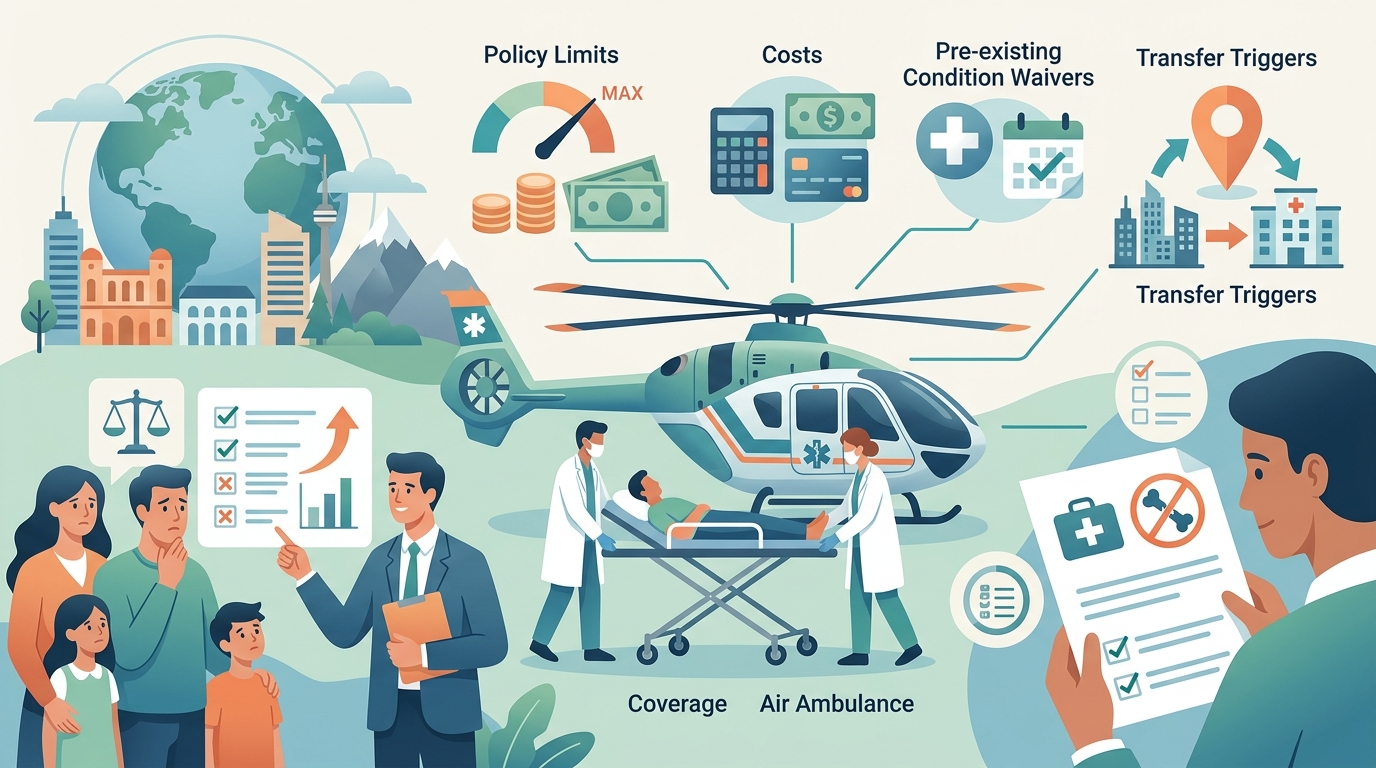
The Financial Reality of International Medical Evacuations
Experiencing a severe illness or traumatic injury while traveling outside your home country presents complex logistical and financial challenges. Domestic health insurance plans, including government programs such as Medicare, rarely provide primary coverage for medical care received abroad and almost never cover international medical transport (Source 1). When a traveler suffers a life-threatening medical emergency in a foreign country, local facilities may lack the specialized equipment, medical personnel, or intensive care capabilities required for stabilization. In these critical situations, emergency medical transport becomes necessary to save lives or preserve long-term health.
Without dedicated medical evacuation coverage, the financial burden of emergency transport falls directly on the individual or their family. The Centers for Disease Control and Prevention (CDC) notes that emergency medical evacuation expenses can easily exceed $100,000 depending on the traveler's location, the severity of the medical condition, and the distance to an appropriate facility (Source 1). According to historical air ambulance provider fee schedules, long-range international air ambulance flights—utilizing specialized fixed-wing aircraft equipped with intensive care units and staffed by flight physicians and critical care nurses—can range from $50,000 for short regional hops to upwards of $250,000 for transoceanic transfers. Understanding the true emergency air ambulance expense travel requires examining aviation logistics, ground transport connections, specialized equipment fees, and global airspace clearance permits.
Evaluating Policy Limits and Recommended Minimums
When evaluating travel medical policies, travelers frequently encounter varying policy limits for medical transport and evacuation. Low-tier travel plans may offer emergency medical evacuation limits as low as $25,000 or $50,000. While these amounts may cover ground ambulance services or short-distance regional transfers within parts of Continental Europe or Central America, they are often insufficient for complex, long-haul evacuations. Insurance industry risk models indicate that a long-distance transport from Asia, Africa, or remote island nations back to North American medical centers routinely depletes low-limit policies before the patient ever leaves foreign airspace.
Industry advisors and travel health organizations generally recommend maintaining international medical coverage limits of at least $250,000 for general international travel, and $500,000 or more for trips to remote regions, polar destinations, or cruises. High policy limits ensure that if a patient requires continuous life support, specialized pediatric or neurosurgical teams, or multi-leg jet transfers, the coverage ceiling will not force families to pay out-of-pocket for remaining flight hours or specialized ground logistics.
| Coverage Tier | Typical Policy Limit | Recommended Destinations | Key Operational Scope |
|---|---|---|---|
| Basic / Budget Tier | $25,000 – $50,000 | Domestic or regional border travel | Basic ground transport and short regional commercial air escorts. |
| Standard Travel Tier | $100,000 – $250,000 | Developed urban areas worldwide | Regional fixed-wing air ambulance to nearest regional medical center. |
| Comprehensive / Remote Tier | $500,000 – $1,000,000+ | Remote regions, cruise travel, adventure spots | Transoceanic air ambulance, dual-pilot critical care crews, specialized transport jets. |
Medical Evacuation vs. Repatriation Coverage
A common point of confusion for international travelers is the distinction between emergency medical evacuation and repatriation coverage. While insurance policies often bundle these benefits together under a single emergency transport section, they fulfill distinct functions during a crisis abroad. The CDC highlights that travelers should explicitly confirm whether a prospective policy covers transport to the nearest adequate facility or return transport to their home country (Source 1).
Emergency medical evacuation covers the immediate transport required to move a patient from the site of an emergency or an inadequate local clinic to the nearest medically capable hospital. In contrast, repatriation coverage addresses the logistics required after a patient is stabilized. Repatriation insurance coverage can pay for commercial airline upgrades (such as lie-flat business class seats required for orthopedic injuries), a medical escort to accompany a recovering patient on a commercial flight home, or, in tragic circumstances, the repatriation of mortal remains. Ensuring both components are robustly funded prevents scenario gaps where a patient is evacuated to a intermediate foreign hospital but left without funding to return home.
Standard Travel Insurance vs. Dedicated Medical Transport Memberships
Travelers seeking comprehensive protection must choose between standard travel medical insurance policies and dedicated medical transport memberships. Standard travel insurance policies operate on an indemnification model. Under these plans, emergency evacuation benefits are triggered only if the local hospital cannot provide adequate medical care for the patient's condition. The decision to evacuate, as well as the target destination, is determined jointly by the attending foreign physician and the insurance company's medical director. If the local facility is deemed 'medically adequate'—even if it falls short of home-country standards—the insurer is not obligated to transport the patient home.
In contrast, dedicated medical transport memberships (such as Medjet or Global Rescue) operate as service programs rather than standard indemnity insurance. These memberships typically feature a 'hospital-of-choice' clause. If a member is hospitalized as an inpatient anywhere abroad, the membership service will arrange and pay for bedside-to-bedside air medical transport to their home-country hospital of choice, regardless of whether the local facility is technically capable of providing basic treatment. However, memberships usually do not cover initial hospital medical bills, making a combination of travel medical insurance and transport membership the most thorough strategy for high-risk or frequent travelers.
| Feature / Capability | Standard Travel Medical Insurance | Dedicated Transport Membership |
|---|---|---|
| Primary Decision Trigger | Medically necessary transfer if local care is inadequate | Inpatient admission threshold met; patient request |
| Destination Hospital | Nearest acceptable or adequate medical facility | Home-country hospital of the member's choice |
| Medical Treatment Costs | Covered up to policy limit for inpatient/outpatient care | Not covered (covers transport logistics only) |
| Typical Target Audience | Vacationers, short-term international tourists | Expats, frequent flyers, adventure travel enthusiasts |
Navigating Hospital-to-Hospital vs. Hospital-to-Home Triggers
Understanding how policy triggers operate in real-world scenarios is crucial before embarking on international travel. The phrase 'nearest adequate facility' is a standard term in conventional travel insurance contracts. For example, if a traveler suffers a severe stroke on an island in the Caribbean, the insurer's evacuation team will coordinate air transport to the nearest hospital with an operational neurology department and ICU unit—which might be in Puerto Rico or Miami, rather than the traveler's home city in Oregon.
Once the patient reaches that adequate facility and receives initial life-saving treatment, the insurer's obligation for emergency evacuation is fulfilled. Further transport home is only approved if medically necessary and if commercial flight options with medical escorts are deemed safe by the insurer's medical panel. Travelers who expect an immediate direct flight from a foreign accident site back to their neighborhood hospital must read policy definitions carefully to verify if hospital-to-home transport is guaranteed or conditional.
Pre-Existing Condition Exclusion Waivers and Look-Back Rules
Pre-existing health conditions represent one of the primary reasons travel insurance medical and evacuation claims are denied. Standard travel policies automatically exclude medical emergencies arising from illnesses, injuries, or health changes that existed prior to the policy's effective date. The CDC warns travelers that pre-existing conditions may not be covered abroad unless specific contractual conditions are met (Source 1).
To determine whether a medical event stems from a pre-existing condition, insurance underwriters utilize a 'look-back period.' The look-back period is a specified window of time—typically 60, 90, or 180 days prior to the policy purchase date. During this window, underwriters review medical records for any new diagnoses, treatment changes, medication dosage adjustments, or recommended diagnostic tests related to the condition that caused the emergency.
To bypass these exclusions, travelers must obtain a travel insurance pre existing conditions waiver. Securing this waiver requires meeting strict timing criteria set by the insurance provider:
- Prompt Purchase Window: The policy and waiver must be purchased within a specified timeframe (usually 10 to 21 days) of making the initial trip deposit.
- Full Trip Coverage: The policyholder must insure 100% of all non-refundable, prepaid trip costs associated with the itinerary.
- Fitness to Travel: The traveler must be medically stable and physically fit to travel on the date the insurance policy is purchased.
- Complete Cost Inclusions: Any subsequent non-refundable travel arrangements added later (such as tours or flight upgrades) must be added to the insured amount within the allowed time frame.
Key Exclusions and Operational Restrictions to Watch For
Even high-limit evacuation policies contain specific exclusions and operational boundaries that can void coverage if unheeded. Policyholders must review contract fine print to identify activity, geographic, and behavioral limitations.
- Adventure and Extreme Sports: High-risk activities such as mountaineering with ropes, scuba diving below certified depths, skydiving, and off-piste skiing are routinely excluded unless an adventure sports rider is purchased.
- Government Travel Advisory Zones: Regions subject to Level 4 'Do Not Travel' advisories issued by foreign affairs agencies or the U.S. Department of State may render evacuation coverage void due to safety risks to flight crews.
- Search and Rescue Limits: Standard evacuation policies cover transport from a hospital or medical site, but do not cover search and rescue operations to locate a lost hiker or missing sailor.
- Substance Involvements: Claims arising from injuries or acute medical events occurring while the insured is under the influence of alcohol or non-prescribed controlled substances are universally excluded.
- Unapproved Third-Party Transport: Attempting to arrange private medical transport independently without prior authorization from the insurer's emergency assistance team will lead to total claim denial.
Practical Checklist Before Traveling Abroad
Preparing for potential health emergencies before departure reduces administrative delays during an actual crisis. The CDC recommends taking practical preparation steps prior to international travel to streamline emergency medical logistics (Source 1).
- Verify Existing Health Coverage: Contact your primary domestic health insurance carrier to confirm what coverage, if any, extends outside national borders (Source 1).
- Select Appropriate Evacuation Limits: Ensure your travel policy provides at least $250,000 to $500,000 in dedicated emergency medical transport coverage, tailored to your destination.
- Secure Waivers Early: Purchase insurance within 10 to 21 days of your initial trip booking if you require a pre-existing conditions waiver.
- Carry Physical Cards and Contact Info: Store physical insurance identification cards and 24/7 emergency assistance phone numbers in your primary travel wallet and smartphone (Source 1).
- Document Emergency Numbers: Save local emergency contact numbers (the foreign equivalent of 911) for every country on your travel itinerary.
How much does medical evacuation insurance cost for a typical international trip?
The cost of travel medical insurance with evacuation coverage generally ranges from 4% to 10% of the total prepaid, non-refundable trip cost. Standalone travel medical policies that focus primarily on health and evacuation benefits rather than trip cancellation often cost between $2 and $10 per day, depending on the traveler's age, destination, and selected coverage limits.
Will my domestic health insurance or Medicare cover emergency evacuation abroad?
Primary domestic health insurance plans, including standard Medicare, rarely cover health care services or emergency air transport outside national borders (Source 1). Some supplemental Medicare plans (Medigap) offer limited emergency foreign medical coverage, but evacuation benefits under these options are usually restricted or non-existent.
What happens if I need an evacuation but forgot to get a pre-existing condition waiver?
If you suffer an emergency related to a pre-existing condition without a valid waiver, the insurer's claims department will review your medical history during the look-back period (usually 60 to 180 days). If records show recent treatments, medication changes, or symptoms related to the condition, the evacuation claim will be denied, leaving you responsible for all transport expenses.
Sources
- Travel Insurance and Medical Evacuation — Centers for Disease Control and Prevention
This article is for general information only and is not professional advice. Figures come from public sources and change over time; check the official source before you act.
More from Real Insight Today
- SBA 7(a) vs. SBA 504 Loans: Interest Rates, Fees, and Qualification Guide
- Bariatric Surgery Out-of-Pocket Costs: Insurance Coverage Rules and Criteria
- Revocable Living Trust vs. Will: Cost, Probate Protection, and Estate Tax Guide
- Enterprise VoIP and UCaaS Pricing: Selection and Licensing Guide for Businesses
- International Medical Evacuation Insurance: Policy Limits, Costs, and Coverage Exclusions
- Commercial Auto Insurance Costs: Coverage Limits and Small Fleet Requirements